
In oilfield exploration, geothermal drilling, and deep water well construction, the tricone roller cone bit remains a highly versatile and reliable tool for overcoming variable downhole geologies. However, with hundreds of geometric configurations, tooth profiles, and bearing designs available, selecting the correct bit can be challenging.
To standardize this process, the International Association of Drilling Contractors (IADC) established a universal classification system. Deciphering the 4-character IADC code allows drilling engineers and procurement managers to instantly understand a bit's design, cutting structure, and intended rock formation compatibility. This guide breaks down the mechanics of IADC coding to ensure high-certainty bit selection for your next drilling project.
Every standard tricone bit is classified by a four-character code (e.g., IADC 517 or IADC 637). Each digit represents a specific mechanical or structural feature of the bit.
       IADC  5  1  7  X
             |  |  |  |
  Series ----+  |  |  |  (Cutting Structure & Rock Hardness)
  Type ---------+  |  |  (Degree of Hardness within the Series)
  Features --------+  |  (Bearing Style & Gauge Protection)
  Additional ---------+  (Supplementary Design Variations)
The first digit ranges from 1 to 8 and defines the overall cutting design and the compressive strength of the target formation:
Steel Tooth / Milled Tooth (Series 1 to 3): These bits feature steel teeth forged or milled directly from the cone steel, typically hardfaced with premium tungsten carbide. They are optimized for low compressive strength, unconsolidated formations.
Series 1: Soft formations (shale, sand, soft limestone).
Series 2: Medium formations (calcites, medium sandstone).
Series 3: Hard, semi-abrasive formations (hard limestone, dolomite).
Tungsten Carbide Insert / TCI (Series 4 to 8): These bits utilize high-grade tungsten carbide inserts pressed into pre-machined cone sockets. They are engineered for high compressive strength and abrasive formations.
Series 4: Very soft to soft formations.
Series 5: Soft-medium to medium formations (medium sandstone, medium schist).
Series 6: Medium-hard to hard formations (hard dolomite, quartz sandstones).
Series 7: Hard and abrasive formations (chert, quartzite, granite).
Series 8: Extremely hard and highly abrasive formations.
The second digit (ranges 1 to 4) further refines the hardness classification within the selected series.
1 represents the softest formation type within that series (designed with long, widely spaced, slim teeth to maximize mechanical scraping).
4 represents the hardest formation type within that series (designed with short, closely spaced, stubby teeth to resist high-impact loading and micro-fracturing).
The third digit (ranges 1 to 7) represents the internal engineering of the bearing package and the level of gauge row wear-protection:
1: Standard open (unsealed) roller bearing. (Mainly for shallow water well drilling).
2: Roller bearing air-cooled (specifically engineered for air drilling applications).
3: Sealed roller bearing with active gauge protection (elastomer O-ring seal to prevent drilling mud from entering the bearing).
4: Sealed friction (journal) bearing. (Highly reliable, uses a copper-alloy bushing instead of rollers to withstand extreme downhole weights).
5: Sealed friction bearing with active gauge carbide inserts. (Premium standard for deep oilfield and heavy-weight geothermal drilling).
7: Sealed friction bearing with specialized protection optimized for directional and motor drilling.
An optional letter suffix can be appended to the three-digit code to represent proprietary mechanical enhancements:
A: Journal bearing bit with standard gauge protection.
G: Extra gauge protection (additional carbide inserts pressed on the cone heel).
Y: Conical insert tooth profiles (optimized for cutting efficiency).
X: Chisel-shaped insert profiles.
To eliminate selection errors, match your target application to these two high-certainty standard configurations:
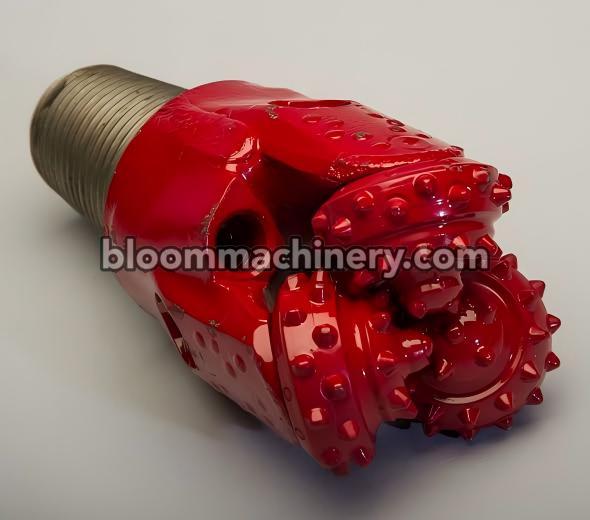
Recommended Code: IADC 517 or IADC 537
Mechanical Logic: The "5" signifies a TCI (Tungsten Carbide Insert) bit suited for soft-medium rock. The "1" or "3" means long, moderately spaced carbide teeth which deliver a highly efficient chipping-scraping action. The "7" indicates a premium sealed journal bearing with active gauge inserts, preventing bearing failure under sustained high-torque rotation in deep water wells.
Recommended Code: IADC 637 or IADC 737
Mechanical Logic: The "6" or "7" Series utilizes heavy-duty, short, hemispherical or stubby dome-shaped carbide inserts that crush hard rock via pure compression. Combined with "7" (sealed journal bearing and maximum gauge protection), the bit maintains hole straightness without losing its gauge diameter.
For extremely deep overburden drilling where vertical percussion is preferred over rotation, consider upgrading to heavy-duty
Even the perfectly selected IADC bit will fail prematurely if run under incorrect parameters. Ensure your drilling team maintains these strict mechanical guidelines:
Weight on Bit (WOB) Management: For Series 1-3 (Milled Tooth), use moderate WOB with higher RPM. For Series 5-7 (TCI), increase the WOB to force the carbide inserts to indent and crush the rock matrix, while keeping the RPM moderate to protect the sealed bearings from thermal degradation.
Hydraulics Optimization: Ensure adequate fluid jetting velocity. Poor cuttings removal causes secondary grinding, which rapidly erodes the cone steel and leads to premature insert loss (tooth-dropping).
At Bloom Machinery, our tricone roller cone bits are manufactured with precision-ground journal bearings, premium heat-treated elastomer seals, and high-density tungsten carbide inserts. This ensures maximum run hours and stable borehole diameters under the most punishing downhole conditions.
Contact: Kevin Dai
Phone: 13605749661
E-mail: sales@bloommachinery.com
Whatsapp:+86 13605749661
Add: Hehua Bridge, Yunlong Town, Yinzhou Distric, Ningbo City, ZheJiang,China