
In quarrying, underground mining, tunneling, and anchoring construction, selecting the optimal interface between your drill steel and the bit is a critical operational decision. For hand-held or pneumatic light-duty rock drills (such as YT24, YT28, or jackhammers), the choice typically boils down to a fundamental mechanical comparison: Tapered Connections vs. Threaded Connections.
While threaded configurations dominate heavy mechanized drifting and production drilling, tapered drilling consumables remain the absolute champion of cost-efficiency for light, hand-held excavation. This article provides an engineering breakdown of both systems to help you choose the most cost-effective drill bit for your specific geology and drilling equipment.
Understanding how these two systems transfer energy from the piston to the rock face reveals why each excels in different operational scales.
Tapered drilling tools rely on a high-precision, friction-fit design. The tapered drill rod features a smooth, machined cone-shaped tip that wedges directly into the mating tapered socket of the drill bit.
Taper Degrees: Industry standard tapers are typically engineered at 7-degree, 11-degree, or 12-degree angles.
7-Degree Taper: Best suited for lightweight rock drills, offering easier bit detachment.
11-Degree & 12-Degree Taper: Designed for higher-power pneumatic drills operating in harder formations, providing a tighter wedge to prevent rotational slippage.
Interlocking Mechanics: As the rock drill delivers high-frequency impacts, the progressive axial force drives the taper joint tighter. This simple, thread-free layout relies entirely on metallurgical surface contact to transfer rotational torque and impact energy.
Threaded systems utilize a physical helical mating profile. Common thread profiles for smaller-scale work include R22, R25, and R28.
Stress Distribution: Thread profiles inherently experience localized stress concentrations at the roots of the helical curves under high-frequency bending forces, making precise metallurgical heat treatment essential to ensure maximum fatigue life.
Torque Transfer: Threaded profiles rely on rotational torque to stay secure. They provide a highly robust, positive-locking connection that requires proper maintenance to prevent thread stripping under continuous mechanical load.
For handheld pneumatic drilling operations, tapered consumables offer unparalleled operational advantages:
Initial Consumable Cost (Very Low): Simpler manufacturing without complex thread-cutting machinery makes tapered bits highly budget-friendly.
Operational Simplicity (Excellent): Bits can be quickly swapped or re-sharpened on-site with simple manual knock-off tools, without needing heavy wrenching.
Susceptibility to Damage (Low): There are no fragile thread profiles to strip, gall, or deform when drilling in muddy, flush-heavy, or abrasive sandy clay environments.
Equipment Compatibility: Seamlessly matches standard, widely-deployed handheld air-leg rock drills (such as the YT28 series) without requiring extra coupling sleeves.
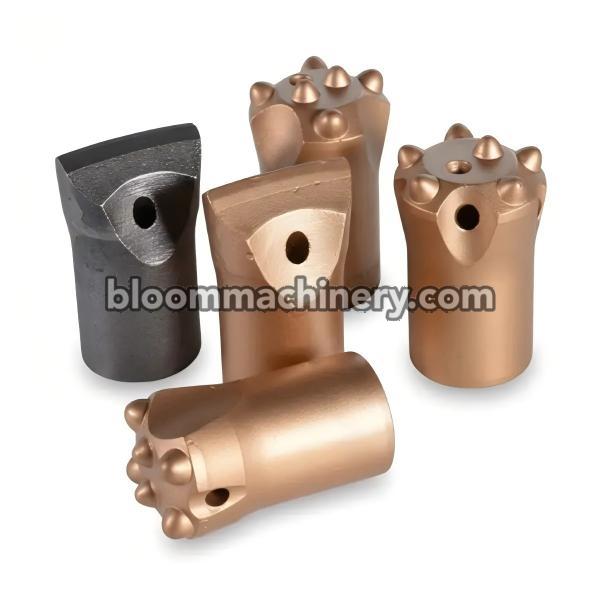
Tapered button bits, chisel bits, and cross bits are the ideal choice when your project involves:
Dimensional Constraints: Small-diameter hole drilling, typically ranging from 28 mm to 45 mm.
Short-Hole Drilling: Optimized for blast holes, block-holing, and bolting applications.
Harsh On-Site Environments: Remote quarries or infrastructure projects where complex maintenance tools are unavailable, and quick manual bit changes are a necessity.
At Bloom Machinery, our tapered bits are forged from high-grade structural alloy steel and paired with premium tungsten carbide buttons to ensure superior structural stability and wear resistance under high mechanical stress.
While tapered systems are the absolute king of cost-effectiveness for hand-held, light-duty operations, they reach their mechanical limits in heavy-duty setups. If your operations scale up to heavy mechanized drifting rigs, hydraulic jumbo drills, or bench drilling setups, the extreme torque and rotational impact forces will overload a friction-fit taper, leading to slippage.
For high-power, heavy-duty continuous excavation, upgrading to engineered
Contact: Kevin Dai
Phone: 13605749661
E-mail: sales@bloommachinery.com
Whatsapp:+86 13605749661
Add: Hehua Bridge, Yunlong Town, Yinzhou Distric, Ningbo City, ZheJiang,China