
In underground drifting, tunneling, and bench drilling, the top hammer drilling system is highly valued for its penetration velocity. However, this efficiency relies on the continuous transmission of high-frequency shockwaves—generated by the rock drill piston—through the drill string to the rock face.
The junction points in this transmitter chain—specifically the interfaces between the shank adapter, coupling sleeve, and male/female drill rods—are the most mechanically vulnerable areas. Thread failure (including thread stripping, coupling breakage, and thread galling) accounts for over 60% of premature drill string retirements.
Preventing these costly failures requires a precise understanding of thread metallurgy, stress distribution, and rigorous on-site matching rules. This guide provides actionable engineering insights to maximize your top hammer consumable life.
To understand thread failure, we must analyze how kinetic energy travels through the connection joints.
When the piston strikes the shank adapter, a compressive stress wave travels down the drill steel at approximately 5,000 meters per second.
At Thread Junctions: Every thread engagement acts as a geometric discontinuity. As the stress wave crosses from the male thread (pin) to the female thread (box/coupling), it does not flow smoothly. Instead, tension and shear stresses concentrate heavily at the root of the first two engaged threads.
Impact of Loose Joints: If the connection between the rod and coupling is not fully tightened (coupled), a micro-gap remains. When the shockwave hits this gap, it reflects back as a tensile wave, generating extreme localized heat (often exceeding 400°C) and causing rapid metal fatigue, thread deformation, or thread fusing (galling).
Selecting the correct thread geometry is the first step in ensuring high-certainty drill string performance under varying geological conditions.
R-threads feature a rounded, sinusoidal profile.
Mechanical Characteristics: They offer a relatively loose fit with a smaller thread pitch, making them exceptionally easy to couple and uncouple manually on-site.
Best Application: Optimized for light-to-medium drifting and tunneling setups (typically using hole diameters under 51 mm) where quick manual bit and rod changes are required.
T-threads feature a flatter, trapezoidal profile with a larger pitch and deeper thread flank.
Mechanical Characteristics: The trapezoidal shape provides a much larger surface contact area, which distributes bending stresses and axial impact energy more evenly across the thread body.
Best Application: Standard for medium-to-heavy mechanized drilling setups (hydraulic jumbo drills and bench rigs). They withstand higher torque and impact energy, significantly reducing thread stripping under heavy load.
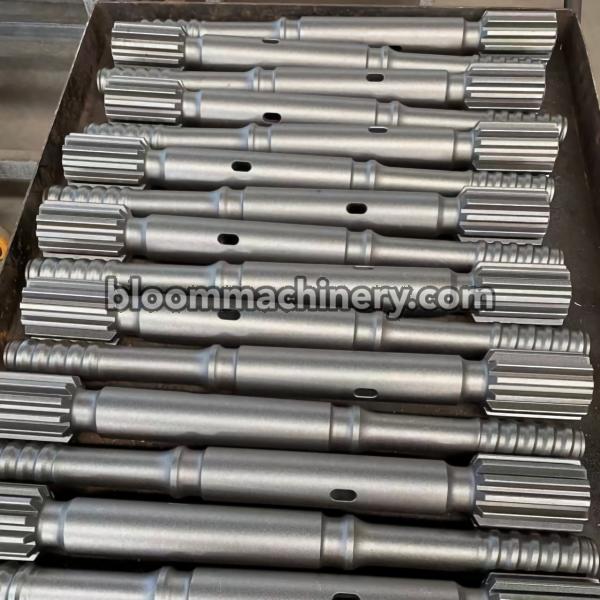
To eliminate premature thread failure, follow these strict mechanical matching rules:
Never couple a brand-new drill rod with a highly worn coupling sleeve, or vice versa.
The Risk: A worn thread has reduced flank contact. Coupling it with a new thread concentrates 100% of the impact force on a single thread point rather than distributing it over the entire thread length. This leads to instantaneous thread stripping.
Action: Group your drill string components by wear cycles. Retire or recondition rods and couplings simultaneously.
Ensure that your shank adapters, couplings, and rods possess matching metallurgic hardness and surface treatment standards.
Carburization (Case Hardening): High-quality consumables must undergo gas carburization. This process diffuses carbon into the outer layer of the steel, creating a highly wear-resistant outer shell (around 58-62 HRC) while maintaining a tough, shock-absorbing inner core.
The Risk of Mismatching: If a cheap, low-carbon coupling is paired with a premium carburized rod, the rod's harder threads will act as a cutting tool, rapidly carving out and destroying the softer coupling threads in just a few drilling cycles.
Failure Mode | Root Mechanical Cause | Direct Preventive Action |
Thread Galling / Fusing | Dry friction under high torque, caused by insufficient lubrication or loose coupling. | Always apply high-purity copper or zinc-based thread grease before coupling; ensure proper thread feed pressure. |
Coupling Splitting | High bending stresses caused by severe hole deflection or drilling through void-rich formations. | Monitor borehole alignment; reduce feed pressure immediately when encountering soft layers or clay seams. |
Thread Stripping (Flattening) | Running mismatched wear profiles or over-torquing beyond metallurgical limits. | Establish strict discard criteria for worn profiles; replace couplings regularly (couplings wear faster than rods). |
To secure the lowest drilling cost-per-meter and keep your drift operations running smoothly, implement the following operational standards:
For Hydraulic Jumbo and Drifter Drills (e.g., Sandvik or Atlas Copco rigs): Always equip your setup with premium, carburized
Implement Discard Limits: Train your drill operators to check thread profiles daily. If the flat top of a T-thread has worn down to a sharp ridge (loss of more than 30% profile volume), the rod must be discarded or re-threaded to protect the rest of the drill string.
Contact: Kevin Dai
Phone: 13605749661
E-mail: sales@bloommachinery.com
Whatsapp:+86 13605749661
Add: Hehua Bridge, Yunlong Town, Yinzhou Distric, Ningbo City, ZheJiang,China