
For drilling and blasting contractors in quarries and open-pit mining operations, selecting between a Top Hammer and a Down-the-Hole (DTH) drilling system is one of the most critical decisions impacting operational expenditure (OPEX) and capital investment.
While both systems serve the same fundamental purpose—crushing rock via percussive impact and rotation—their mechanical energy transmission paths are fundamentally different. This technical brief evaluates both systems across key operational parameters to assist fleet managers in optimization.
The defining engineering variance lies in where the percussive blow is generated relative to the rock face.
Top Hammer:  [Hydraulic Drifter] ---> [Shank] ---> [Drill Rods] ---> [Bit] ---> Rock Face
DTH Drilling: [Rotation Unit] ---> [Drill Pipe] ---> [DTH Hammer + Bit] ---> Rock Face
Top Hammer Drilling: The impact energy is generated by a hydraulic drifter mounted on the rig's feed. The shockwave must travel through the shank adapter and the entire drill rod string before reaching the bit.
DTH Drilling: The pneumatic DTH hammer is positioned directly at the bottom of the hole. The piston strikes the shank of the DTH bit directly, meaning the percussive energy does not have to travel down the drill string.
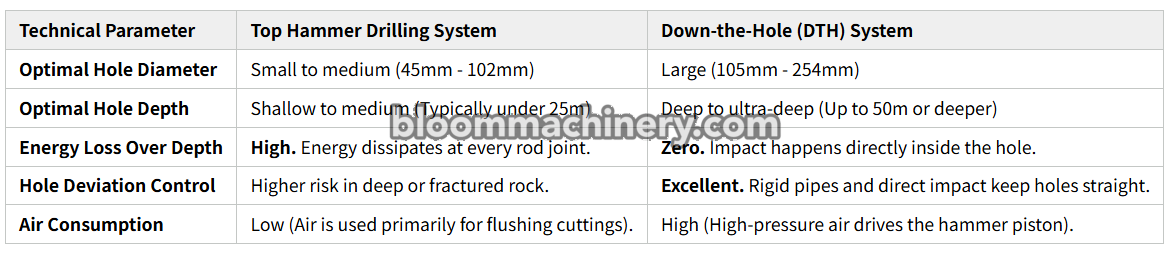
Targeting Small Hole Diameters: If your production blasting grid requires holes under $102\text{mm}$, top hammer systems deliver unrivaled penetration rates (ROP). The high blow frequency of modern hydraulic drifters crushes rock rapidly at small diameters.
Shallow Bench Mining & Quarrying: In aggregate quarries with shallow benches (under $20\text{m}$), energy dissipation across the drill string is minimal, making it highly fuel-efficient.
Complex Civil Anchoring/Bolting: Applications requiring rapid, high-frequency setup changes—such as tunneling or slope stabilization—benefit from the lightweight versatility of systems like the
Drilling Deep Production Holes: Because percussive energy remains constant regardless of depth, DTH is the only economically viable option for deep-hole production mining.
Hard, Fractured, or Abrasive Formations: In formations where top hammer rods would flex, suffer heavy joint wear, or cause severe hole deviation, a heavy-walled DTH drill string ensures straight holes. This precision minimizes sub-drill costs and ensures clean fragmentation during blasting.
Large-Scale Bench Operations: For large open-pit operations utilizing high-pressure air compressors to drive heavy-duty bits (such as DHD, Mission, or QL series), DTH provides the structural stability required for continuous $24/7$ extraction.
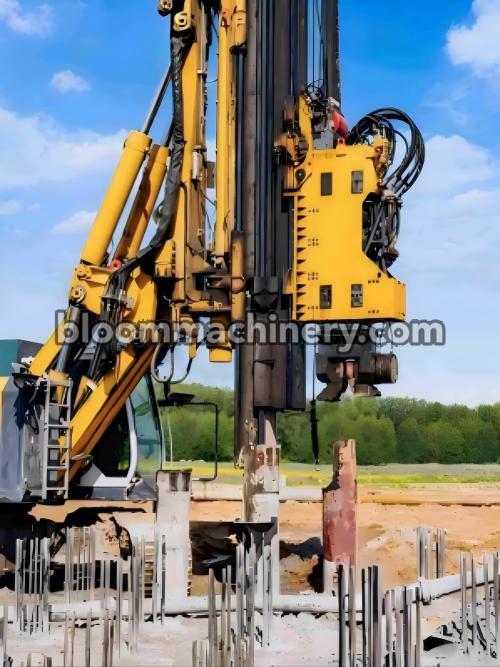
From a procurement perspective, both systems present distinct wear profiles. Top hammer setups subject the drill string to intense tensile and compressive stresses, requiring precision-carburized
Conversely, DTH systems isolate the drill pipe from percussive shock but demand rigid manufacturing controls on the hammer components and bit heads. Because DTH bits operate under sustained high pressure at the hole bottom, the quality of the carbide buttons is paramount to prevent sudden shank breakage.
Technical Summary
Contractors should avoid the mistake of applying one system universally. For small-diameter benching and structural bolting under 102mm, look to optimize your hydraulic rig outputs using precision-matched top hammer strings. For heavy surface mining, deep-hole consistency, and large-diameter production blasting, a high-pressure DTH setup remains the industry benchmark for lowest cost-per-ton.
Contact: Kevin Dai
Phone: 13605749661
E-mail: sales@bloommachinery.com
Whatsapp:+86 13605749661
Add: Hehua Bridge, Yunlong Town, Yinzhou Distric, Ningbo City, ZheJiang,China