
When drilling deep water wells—especially when targeting aquifers past 150 meters—drilling crews frequently encounter a sharp drop in their Rate of Penetration (ROP). Even with the rig running at full throttle and high air pressure, the tool seems to grind in place without making progress.
In deep water well construction, this issue is rarely caused by a dull bit alone. The primary culprit is usually hydrostatic back-pressure combined with poor hole flushing.
As a dedicated rock drilling tool factory, we know that if your DTH bit cannot clear water and rock cuttings out of the path instantly, you wind up re-crushing old debris, burning fuel, and risking a stuck tool string.
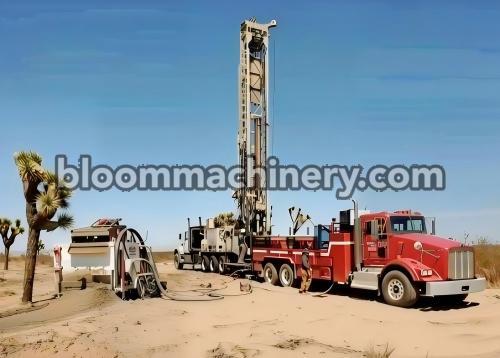
As a water well gets deeper and hits water-bearing zones, a dense column of water and heavy sludge accumulates at the bottom of the hole. This creates massive hydrostatic resistance that fights against the compressed air coming out of your hammer.
If the air flow loses velocity, the rock cuttings cannot lift. Instead, they fall back down, creating a thick mud blanket over the rock face.
The Result: The carbide buttons waste impact energy pounding on loose sludge rather than solid rock.
The Danger: If you lose air pressure suddenly, this suspended sludge drops onto the top of the bit head, packing it tight and trapping your drill string in the hole.
To break through this water column, you need an aggressive air delivery strategy matched with bits like the QL60-165mm or Mission60-165mm that are engineered specifically for high-volume flushing.
At Bloom Machinery, we design our 6-inch water well bits with specific fluid dynamics in mind to ensure that air and water are evacuated from the working face at high velocity:
Expanded Flushing Grooves: On our QL60-165mm and Mission60-165mm lines, we widen and deepen the standard chip paths (sludge grooves) on the sides of the bit head. This creates a low-resistance escape route, allowing large rock chips and heavy water mud to bypass the tool head without choking the annulus.
Optimized Dual Air Holes: Instead of a single central flush port, our water well configurations utilize angled dual or triple air holes. This directs the air stream directly across the outer gauge buttons where the most cuttings are generated, sweeping the rock face clean before the next hammer strike.
Strict Metallurgy Against Body Wash: Pushing abrasive quartz sand and water past a bit head at high speeds creates a severe sandblasting effect known as "body wash." We forge our bits from premium Timken/Sanyo nickel-alloy steel to prevent this slurry from eroding the steel matrix that holds the carbide inserts.
Our Flushing Baseline: Deepened Side Grooves + Angled Jet Holes + Wear-Resistant Alloy Body = Clean Holes and High ROP
To see how we maintain micron-level tolerances on these large 165mm bit heads to prevent other failures, read about our
Achieving a clean hole requires looking at the compressor setup and the tool layout as a unified system. If your water well rig is struggling to clear mud, consider these practical adjustments:
Match the Hammer Foot Valve: Ensure your bit's foot valve (blow tube) matches your 6-inch hammer perfectly. A leaking or slightly cracked foot valve drops air pressure right at the joint, robbing the bit face of the pressure needed to lift water.
Utilize Check Valves in Wet Strata: When drilling into heavy water-producing zones with our QL60 or Mission60 setups, we highly recommend running an internal check valve inside your DTH hammer. This prevents water and sand from back-flowing into the bit sockets and hammer internals when you break joints to add drill rods.
Ground Condition: Deep Aquifers / Highly Fractured Limestone with High Water Inflow
Site Challenge: Severe mud plastering; ROP drops by half; high risk of stuck tools.
Our Recommended Approach: QL60-165mm Concave Face bit with maximized side flushing grooves paired with a high-pressure compressor (minimum 25-30 bar).
Expected Result: Constant cutting ejection; stable drilling speed through high-volume water zones.
If you are dealing with shifting fractured rock layers that cause your water well path to drift, review our guide on
Bloom Machinery operates a focused, mid-sized production facility. We don't just push out standard parts; we build tools for guys who deal with messy real-world drilling environments every day.
If your water well operation is losing money because of slow deep-hole performance or frequent tool packing, let's talk tech. We can look over your compressor capacities, review drawings for our QL60 and Mission60 lines, and supply a balanced package that handles the pressure.
[Contact Our Engineering Office for a Direct Water Well Tool Consultation]
Contact: Kevin Dai
Phone: 13605749661
E-mail: sales@bloommachinery.com
Whatsapp:+86 13605749661
Add: Hehua Bridge, Yunlong Town, Yinzhou Distric, Ningbo City, ZheJiang Province