
When procuring rock drilling tools, choosing the correct bit face and carbide grade is only half the battle. The most critical factor for mechanical energy transfer happens at the back of the tool: the Shank Spline Configuration.
The shank is the male connection section that slides inside the driver chuck of the DTH hammer. The vertical ridges, or splines, are responsible for transferring massive rotational torque from the drill string into the bit head while withstanding high-frequency impact waves from the piston.
The global market is dominated by three classic standard designs: DHD, Mission, and QL (Quantum Leap). While a DHD360-165mm, a Mission60-165mm, and a QL60-165mm bit can all drill the exact same 6 1/2" hole, their internal mechanics, spline surface areas, and operational lifespans vary dramatically depending on the ground environment.
To understand how these shanks perform, you have to look at how rotation forces contact the steel walls inside the hammer driver chuck.
The DHD shank (such as DHD340 for 4-inch or DHD360 for 6-inch setups) is the global benchmark. It features a robust, deep-groove spline pattern designed for general all-round stability.
The Advantage: Because DHD is universally produced, parts are highly interchangeable and cost-effective. The thick spline profile offers excellent resistance against shearing forces.
The Limit: In high-torque environments, the contact area can experience localized stress concentration, requiring steady lubrication to prevent galling.
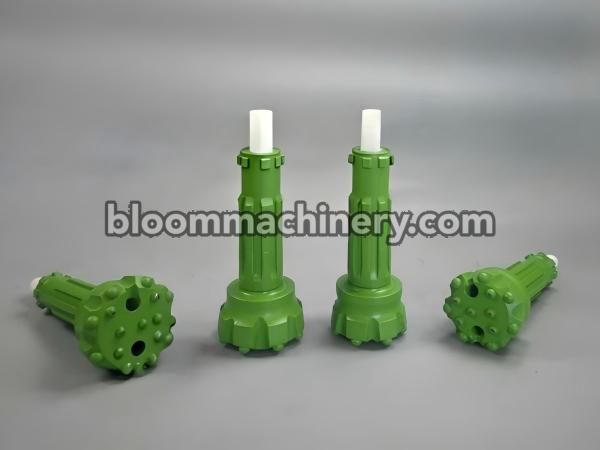
The Mission style shank (such as Mission40 and Mission60) utilizes a higher count of shallower, flatter splines compared to DHD.
The Advantage: By distributing the rotation force across more splines, the Mission configuration reduces individual point-stress. This makes it highly efficient at transferring torque in sticky, changing formations where rotational resistance spikes suddenly.
The Limit: The shallower splines mean that if your hammer driver chuck becomes worn out, slippage or rounding can occur faster than with a DHD setup.
The QL series (such as QL60-165mm) was engineered as a high-performance upgrade for extreme deep-hole applications like deep water wells.
The Advantage: QL bits feature an optimized shank length and broad spline footprints. Furthermore, the internal air porting and blow-tube matching allow for massive air volume passage, keeping back-pressure low.
The Limit: It demands a top-tier compressor setup to truly utilize its design efficiency; under-powering a QL tool system defeats its performance purpose.
No matter which shank configuration your site demands, poor machining tolerances at the factory will cause premature failure. If the splines on a Mission40 or DHD360 bit are machined even a fraction of a millimeter off-axis, the rotation load will bear down on just one or two splines rather than distributing evenly. This leads to spline shearing or a cracked shank body.
At Bloom Machinery, we stabilize this connection right on the shop floor:
Multi-Axis CNC Spline Milling: We utilize multi-axis CNC milling centers to cut all splines in a single setup. This ensures absolute indexing symmetry across all grooves.
Controlled Surface Hardness: The shank must remain flexible enough inside to absorb the brutal hammer piston shock waves, yet the outer spline surfaces must be hard enough to resist frictional wear. We achieve this through proprietary localized heat treatment.
To get the longest life out of your consumable budget, you cannot view the bit as an isolated piece of steel. It must be perfectly matched to the upward components of your DTH system.
A QL60 bit must go into a high-performance
The rotational torque that drives these splines starts at the rig动力头 (top drive) and passes through the DTH Drill Rods.
For smaller 4-inch setups like DHD340 or Mission40, standard 76mm drill pipes utilizing an API 2 3/8" REG thread provide the correct balance of torque resistance and air velocity.
For heavy 6-inch applications like DHD360, Mission60, or QL60, upgrading to 89mm or 102mm rods with API 3 1/2" REG threads ensures the mechanical backbone can handle the rotation without twisting or stripping at the joints.
Application: Hard Quarry Blasting & Standard Mining
Recommended Shank Layout: DHD Series (DHD340 / DHD360)
System Setup: Pair with standard high-pressure (Valveless Hammers) and standard API threads.
Application: Civil Engineering, Piling & Shifting/Sticky Strata
Recommended Shank Layout: Mission Series (Mission40 / Mission60)
System Setup: Pair with high-torque rotational drives and thick-walled drill rods to absorb torsional flexing.
Application: Deep Aquifer Water Well Construction (Past 150m)
Recommended Shank Layout: QL Series (QL60)
System Setup: Pair with high-cfm compressors and heavy-duty, large-diameter flushing pipes.
At Bloom Machinery, we don't just specialize in one single profile. We run a capable, mid-sized production facility engineered to produce high-tolerance DHD, Mission, and QL configurations under strict quality control.
More importantly, we are a manufacturing partner that helps you configure the whole string. If you are setting up a new drilling contract and need to map out the perfect match between your rig's compressor capacity, your DTH Hammer choice, your Drill Rod threads, and the ultimate Bit Shank profile, get in touch with our office. Let's look over the technical data sheets and build a system that delivers maximum reliability.
[Contact Our Technical Office for an Integrated System Configuration Consultation]
Contact: Kevin Dai
Phone: 13605749661
E-mail: sales@bloommachinery.com
Whatsapp:+86 13605749661
Add: Hehua Bridge, Yunlong Town, Yinzhou Distric, Ningbo City, ZheJiang,China